Suit of Hearts · 5 saka Cups
Lima hati Cithakan:Kartu Tarot
- Tegak
- kathah
- Dibalik
- tanggapnggegirisingapuranglampahi rasa duka
- Ya utawa ora
- Ora
- Unsur
- Water
- Astronomi
- Mars in Scorpio
Apa kang ditampilake ing kartu
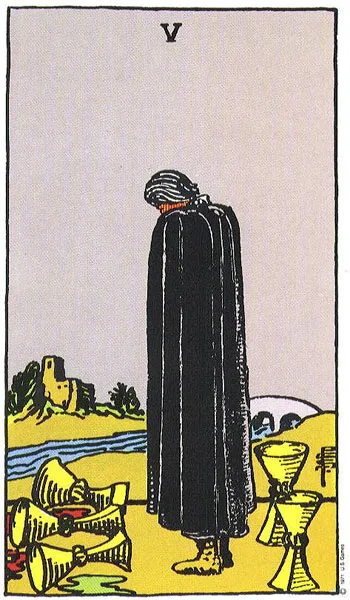
A figure in a long black cloak stands with head bowed before three cups lying overturned, their contents soaking into the ground. Behind him, fully outside his lowered gaze, two cups remain standing and full. A river runs across the scene, and further along it a bridge crosses to a small castle on the far side. Everything he mourns is real. So is everything he cannot currently see: the two cups, the bridge, the way home.
Lima hati: upright meaning
Ing cekak: Nanging, yèn ora ana kang bisa ngrampungaké masalah iki, ora ana sing bisa ngrampungaké masalah iki.
The spill happened, and it mattered. The Five of Cups does not rush anyone: something real was lost: a relationship, a chance, a version of the future you had already moved into emotionally, and the black cloak is appropriate dress. Grief is not a malfunction; it is the cost of having cared. But the card is painted with brutal precision: three cups down, two still standing, and the mourner positioned so he can only see the three. Loss narrows vision as a side effect, and the narrowing can outlast the loss. You do not have to feel grateful yet. You only have to turn around eventually: the remaining cups and the bridge across the river are not going anywhere, but you are not looking at them either.
Lima hati: reversed meaning
Ing cekak: Ing jaman kuna, para dewa lan para dewawati iku digambarake kanthi wujud manungsa.
Reversed, the head lifts. This is one of the most hopeful reversals in the deck: grief completing its work, the slow pivot toward the two standing cups, forgiveness, of others or of yourself, becoming physically possible. The regret loses its magnetism; you catch yourself thinking of other things. Sometimes it warns of the opposite: mourning that has become a residence, loss rehearsed so long it turned into identity, refusing comfort because comfort feels like betrayal of what spilled. If the grief is old and the story of it has stopped changing, the reversal is your cue. The bridge in the picture was always load-bearing.
Lima hati: love & relationships
Tegak
Heartbreak, or its long shadow: a breakup being actively grieved, a betrayal not yet metabolized, or an old loss quietly running your current relationship from the back seat. The card honors the pain and asks one thing of you: do not let three spilled cups convince you all five are gone. What remains, in this relationship or in your capacity for the next, is more than the grief is currently reporting.
Dibalik
Ing jaman biyèn, wong-wong kang padha nyambut gawe ing pabrik-pabrik, utawa ing pabrik-pabrik kang ana ing pinggir dalan, bisa uga ora ngerti yèn ana wong kang nyambut gawe ing pabrik-pabrik mau, nanging ing jaman saiki, wong-wong mau wis bisa ngerti yèn ana wong-wong kang nyambut gawe ing pabrik-pabrik mau.
Lima hati: kariré & dhuwit
Tegak
A professional loss stings: the job gone, the venture failed, the promotion that went elsewhere, and disappointment is coloring how you see everything left. Mourn the specific loss on purpose, briefly and thoroughly. Then audit what survived it: skills, allies, reputation, runway. Financially, do not make decisions while staring at spilled cups; grief-driven money choices compound the loss.
Dibalik
Recovery footing. Lessons from the failure become usable instead of just painful; a setback stops being the whole story and becomes a chapter. Rebuilding is favored now: reapply, relaunch, renegotiate. The main risk is carrying the old defeat into the new attempt as prophecy. What spilled taught you where the ground is uneven. That is all it gets to decide.
Lima hati: ya utawa ora?
Ora.
No, at least, not from here. The Five of Cups marks loss, regret, and a perspective currently fixed on what went wrong, and questions asked from that posture rarely resolve the way you hope. It is a no about the present course, not a curse on the future: once grief is processed and the standing cups are counted, the situation often reopens. For now, mourn first, decide later.
Kartu sing gegayutan

Takon kang asring diajukake
Apa kartu iki bakal nemokaken sampeyan dina iki?
Nglebokaké kartu iki ing maca langsung →