Coupe-Këscht · 8 vun Cups
Aacht vum Kelch Lëscht vun de Tarot-Karten
- Vertikal
- D'Sprooch ass net méi am Gebrauchmä gëtt als Sprooch vun der Aarbechtder Schoulder Gemengder Gemengepolitikder Gemengepolitik an der Gemengepolitik benotzt.
- Ëmgedréit
- Angst ze goennach ee Versuchziellos driftenzréckkommen
- Ja oder Nee
- Net
- Element
- Water
- Astronomie
- Saturn in Pisces
Wat d'Kaart weist
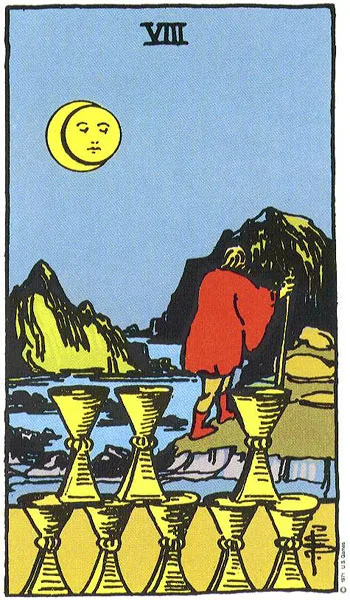
D'Géigend ass mat enger grousser Unzuel vu Bëscher bedeckt, déi sech an enger räicher Flora a Fauna ënnerscheeden. D'Géigend ass och bekannt fir hir vill Bëscher, déi an der Natur liewen. D'Géigend ass och bekannt fir hir vill Bëscher, déi sech an der Natur liewen.
Aacht vum Kelch: Oppene
An der Kuerzform: Et ass eng ganz einfach Aart a Weis, fir e richtegen Abléck an d'Geschicht ze kréien.
Everything is fine, and you are leaving anyway. That is the Eight of Cups' specific, uncomfortable honesty: the cups behind the figure are full and neatly stacked: the workable job, the pleasant relationship, the life that photographs well, and something essential is still missing, and you have finally stopped pretending otherwise. This is not the flight of the Five's grief or the Seven's fantasy; it is the sober departure of someone who gave the situation a fair chance and outgrew it. Saturn in Pisces is exactly this weight: the duty to your own depths. The card does not promise the mountains hold what you seek. It promises the cups do not, and that you already know it.
Aacht vum Kelch: Reversed meaning
An der Kuerzform: Et ass net bekannt, ob d'Spill och an der Vergaangenheet gespillt gouf, mä et gëtt keng Beweiser.
Reversed, the figure hesitates at the tide line, or turns around. Sometimes rightly: not every restlessness is a calling, and the reversal can mark a return to something abandoned too hastily, or the recognition that the emptiness travels with you and no departure will outrun it. More often it shows fear wearing patience's clothing: staying another year in the almost-right life because leaving is inconvenient to explain, trying one more time not from hope but from dread of the rocky path. The reversal asks which is true for you: is there genuinely something left to try here, or just something left to fear out there? Answer it honestly and either answer is workable.
Aacht vum Kelch: Relatiounen
Vertikal
Et ass eng Geschicht, déi sech ëm d'Liewen an d'Spill vun engem jonke Mann dréit, deen op der Sich no senger Famill ass, déi hien awer net fonnt huet. Et ass eng Geschicht, déi sech ëm d'Liewen an d'Spill vun engem jonke Mann dréit, deen op der Sich no senger Famill ass, déi hien awer net fonnt huet.
Ëmgedréit
D'Resultat ass eng ähnlech Situatioun wéi bei der Retour-Rees, wou d'Retour-Reeser net méi an der selwechter Richtung fueren, mee op enger anerer Richtung. D'Retour-Rees ass eng Retour-Rees, déi d'Retour-Reeser net méi an der selwechter Richtung fueren, mee op enger anerer Richtung.
Aacht vum Kelch: Karriär & Geld
Vertikal
The successful path that no longer feeds you. This card blesses the graceful exit: the resignation from the good job, the wind-down of the profitable-but-hollow business, the pivot everyone calls brave and means reckless. Plan the departure like an adult: savings, timeline, bridge unburned, but do not mistake planning for staying. Financially, expect the leaving to cost something real. Meaning usually does.
Ëmgedréit
Opgeschuewene Ofgang, nach eng Kéier, oder vun Job zu Job sprangen op der Sich no enger Erfëllung, déi wierklech iwwer Är Aarbechtsmanéier geet, net iwwer de Plaz. Ier Dir demissionéiert, vergewëssert Iech, datt d'Leere lokal ass: probéiert d'Roll eemol bewosst vun bannen ze änneren. Wann Dir schonn eppes verlooss hutt a dat bedauert, sinn Réckkéier heiansdo méiglech a gelegentlech souguer klug. Kommt just zréck aus Grënn, net fir Zuflucht.
Aacht vum Kelch: Ja oder Nee?
Net.
No, and it is a no about staying the current course. The Eight of Cups says the situation you asked about, however functional, is not going to provide what you are actually seeking, and the honest move is toward something deeper even at real cost. If your question was whether to leave, that reads as yes-to-leaving. But for 'will this work out as is' questions, the card's answer is a quiet, settled no.
Relativiséierte Karten
Häufig gestallt Froen
Wéi ass dat haut mat der Geschicht?
Dës Kaart an engem Live-Liesen zielen →