Kouch · 8 nan Cups
otòn kès Tarot Card siyifikasyon an
- Vertikal
- kite sachèche yon sans ki pi fonkite sa ki sifirechèchdepa nesesè
- Retounen
- laperèz pou kiteyon dènye tantativderiv san direksyonretounen
- Wi oswa Non
- Non
- Eleman
- Water
- Astrologi
- Saturn in Pisces
Ki sa kat la montre
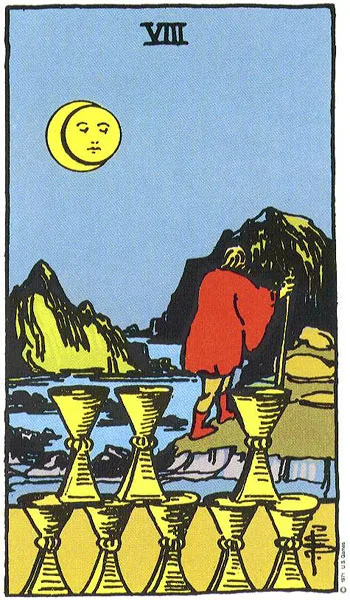
Nan yon eklipse lune, yon figi ki gade nan yon bagay tankou sympathique, yon figi ki te kouvri ak yon manto, ki te gen yon baton nan men l, te ale lwen de etaj la nan yon wout ki te plen wòch ant depo dlo ki te gen ti dlo, nan direksyon pou mòn yo. Koup yo te mete byen an premye plan an, pa gen okenn ki te tonbe, pa gen okenn ki te kraze, yon espas nan tèt la nan yon ranje kote yon senkyèm ta ka te fini. Li pa gade tounen. Depa a te fèt an bon jan kalite, chwazi, ak fè nan lannwit, lè kite a pi piti mal pou wè.
otòn kès: upright meaning
Nan kout: Everything's fine and you're leaving anyway: honor the pull to walk toward something truer.
Everything is fine, and you are leaving anyway. That is the Eight of Cups' specific, uncomfortable honesty: the cups behind the figure are full and neatly stacked: the workable job, the pleasant relationship, the life that photographs well, and something essential is still missing, and you have finally stopped pretending otherwise. This is not the flight of the Five's grief or the Seven's fantasy; it is the sober departure of someone who gave the situation a fair chance and outgrew it. Saturn in Pisces is exactly this weight: the duty to your own depths. The card does not promise the mountains hold what you seek. It promises the cups do not, and that you already know it.
otòn kès: Retounen
Nan kout: Ou pa twò kontan, ou pa twò kontan, ou pa twò kontan, ou pa twò kontan, ou pa twò kontan, ou pa twò kontan.
Reversed, the figure hesitates at the tide line, or turns around. Sometimes rightly: not every restlessness is a calling, and the reversal can mark a return to something abandoned too hastily, or the recognition that the emptiness travels with you and no departure will outrun it. More often it shows fear wearing patience's clothing: staying another year in the almost-right life because leaving is inconvenient to explain, trying one more time not from hope but from dread of the rocky path. The reversal asks which is true for you: is there genuinely something left to try here, or just something left to fear out there? Answer it honestly and either answer is workable.
otòn kès: Love & relasyon
Vertikal
Someone is emotionally packing, or already gone in every way but logistics. This card marks the departure from relationships that are pleasant and insufficient: no villain, no explosion, just the quiet certainty that staying costs a self. If it is you: leave cleanly and kindly, without manufacturing a crime to justify it. If it may be your partner: the withdrawal you sense is probably real, and worth naming before the walking starts.
Retounen
Ou ka santi w tankou yon moun ki te pèdi yon moun ki te renmen l, epi ou pa ka retounen nan relasyon an. Ou ka santi w tankou yon moun ki te pèdi yon moun ki te renmen l, epi ou pa ka retounen nan relasyon an. Ou ka santi w tankou yon moun ki te pèdi yon moun ki te renmen l, epi ou pa ka retounen nan relasyon an. Ou ka santi w tankou yon moun ki te pèdi yon moun ki te renmen l, epi ou pa ka retounen nan relasyon an.
otòn kès: Kariè & lajan
Vertikal
The successful path that no longer feeds you. This card blesses the graceful exit: the resignation from the good job, the wind-down of the profitable-but-hollow business, the pivot everyone calls brave and means reckless. Plan the departure like an adult: savings, timeline, bridge unburned, but do not mistake planning for staying. Financially, expect the leaving to cost something real. Meaning usually does.
Retounen
Quitting deferred another quarter, again, or job-hopping in search of a fulfillment that is really about how you work, not where. Before resigning, verify the emptiness is local: try changing the role from inside once, deliberately. If you already left something and regret it, returns are sometimes possible and occasionally even wise. Just return for reasons, not for refuge.
otòn kès: Wi oswa non?
Non.
No, and it is a no about staying the current course. The Eight of Cups says the situation you asked about, however functional, is not going to provide what you are actually seeking, and the honest move is toward something deeper even at real cost. If your question was whether to leave, that reads as yes-to-leaving. But for 'will this work out as is' questions, the card's answer is a quiet, settled no.
Kat ki gen rapò
Kesyon ki poze souvan
Èske kat sa a ka jwenn ou jodi a?
Tire kat sa a nan yon lekti viv →