Oireann na gCupán · 8 de Cups
an t-ocht cupán Tarot Cárta Brí
- Ingearach
- siúl ar shiúlag lorg brí níos doimhneag fágáil an maith-go leorrompuimeacht riachtanach
- Inbhéartaithe
- eagla a fhágáiliarracht amháin níos módrifting aimlessag filleadh
- Tá nó Níl
- & Ná Sábháil
- Mír
- Water
- Astrology
- Saturn in Pisces
Cad a thaispeánann an cárta
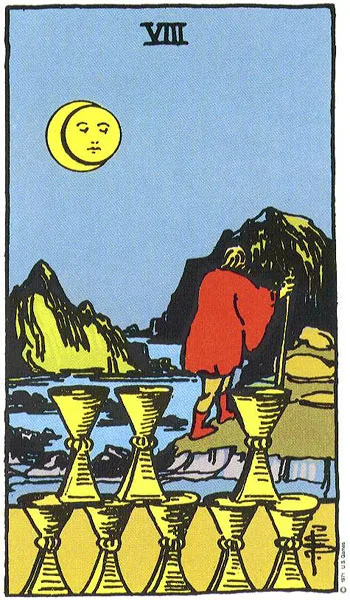
Under an eclipsed moon whose face looks down with something like sympathy, a cloaked figure walks away from eight golden cups, staff in hand, heading up a rocky path between tidal pools toward mountains. The cups are stacked neatly in the foreground: none spilled, none broken, one gap in the top row where a ninth might have completed the set. He does not look back. The departure is orderly, chosen, and made at night, when leaving hurts least to watch.
an t-ocht cupán: upright meaning
Go hachomair: Everything's fine and you're leaving anyway: honor the pull to walk toward something truer.
Everything is fine, and you are leaving anyway. That is the Eight of Cups' specific, uncomfortable honesty: the cups behind the figure are full and neatly stacked: the workable job, the pleasant relationship, the life that photographs well, and something essential is still missing, and you have finally stopped pretending otherwise. This is not the flight of the Five's grief or the Seven's fantasy; it is the sober departure of someone who gave the situation a fair chance and outgrew it. Saturn in Pisces is exactly this weight: the duty to your own depths. The card does not promise the mountains hold what you seek. It promises the cups do not, and that you already know it.
an t-ocht cupán: aistrithe
Go hachomair: Tá tú ag leisce ort ag an imeall, nó go leanfadh an restlessness díreach tú; déan cinnte nach bhfuil tú ag fágáil ró-hastily.
Reversed, the figure hesitates at the tide line, or turns around. Sometimes rightly: not every restlessness is a calling, and the reversal can mark a return to something abandoned too hastily, or the recognition that the emptiness travels with you and no departure will outrun it. More often it shows fear wearing patience's clothing: staying another year in the almost-right life because leaving is inconvenient to explain, trying one more time not from hope but from dread of the rocky path. The reversal asks which is true for you: is there genuinely something left to try here, or just something left to fear out there? Answer it honestly and either answer is workable.
an t-ocht cupán: grá & caidrimh
Ingearach
Someone is emotionally packing, or already gone in every way but logistics. This card marks the departure from relationships that are pleasant and insufficient: no villain, no explosion, just the quiet certainty that staying costs a self. If it is you: leave cleanly and kindly, without manufacturing a crime to justify it. If it may be your partner: the withdrawal you sense is probably real, and worth naming before the walking starts.
Inbhéartaithe
Standing in the doorway, unable to leave and unable to stay well. Or a return: an ex coming back, you going back. That needs one hard question answered first: what has actually changed? The reversal also covers drifting between partners seeking a depth that no partner can supply. Sometimes the thing being fled lives inside, and it makes the trip every time.
an t-ocht cupán: gairme & airgead
Ingearach
The successful path that no longer feeds you. This card blesses the graceful exit: the resignation from the good job, the wind-down of the profitable-but-hollow business, the pivot everyone calls brave and means reckless. Plan the departure like an adult: savings, timeline, bridge unburned, but do not mistake planning for staying. Financially, expect the leaving to cost something real. Meaning usually does.
Inbhéartaithe
Quitting deferred another quarter, again, or job-hopping in search of a fulfillment that is really about how you work, not where. Before resigning, verify the emptiness is local: try changing the role from inside once, deliberately. If you already left something and regret it, returns are sometimes possible and occasionally even wise. Just return for reasons, not for refuge.
an t-ocht cupán: Tá nó níl?
& Ná Sábháil.
No, and it is a no about staying the current course. The Eight of Cups says the situation you asked about, however functional, is not going to provide what you are actually seeking, and the honest move is toward something deeper even at real cost. If your question was whether to leave, that reads as yes-to-leaving. But for 'will this work out as is' questions, the card's answer is a quiet, settled no.
Cártaí gaolmhara
Ceisteanna Coitianta
An bhfaighfeá an cárta seo inniu?
Tarraing an cárta seo i léitheoireacht bheo →