D'Spill vun de Wands · 5 vun Wands
Fënnef vum Stab Lëscht vun de Tarot-Karten
- Vertikal
- KonfliktKonkurrenzKonfliktKonkurrenzKon
- Ëmgedréit
- Konflikter vermeidenSpannungen bremsenintern KämpfÄre Kampf wielen
- Ja oder Nee
- Net
- Element
- Fire
- Astronomie
- Saturn in Leo
Wat d'Kaart weist
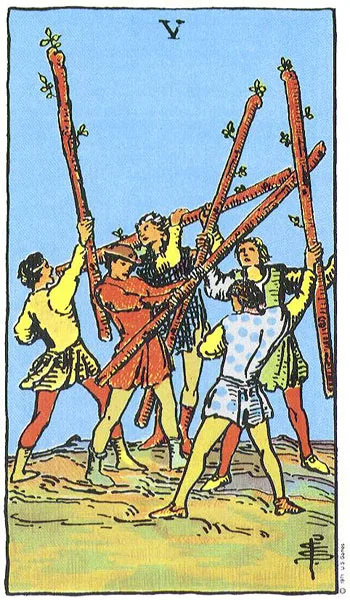
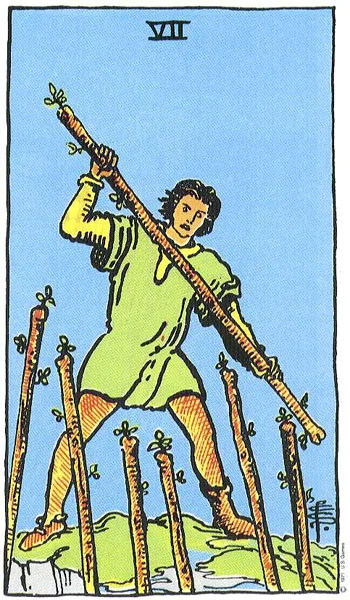
Five young men swing five staves in a chaotic tangle, each striking at nothing in particular. Look closely and no one is actually hurt: no blood, no fallen figure, staves clacking against staves rather than bodies. Their clothes are all different, five uniforms for five agendas. It reads as much like a rowdy training bout as a battle, and that ambiguity is the card's whole question: is this fight real, is it practice, or is it just noise?
Fënnef vum Stab: Oppene
An der Kuerzform: Et ass net bekannt, ob et eng Verbindung tëscht der Geschicht an der Realitéit gëtt, mä et ass net sécher.
Everyone is talking and nobody is listening. The Five of Wands is friction: competing egos, rival bids, a team pulling in five directions, the group chat on fire over something that will not matter in a month. Saturn in Leo grinds authority against pride. The useful truth inside the card: this conflict is usually more noise than damage, and sometimes it is even productive, the way sparring sharpens a fighter. Competition can surface the best idea if someone imposes rules on the scrum. But do not mistake motion for progress. Ask what is actually being decided here, and whether you need to be in the middle of it.
Fënnef vum Stab: Reversed meaning
An der Kuerzform: Et ass net bekannt, ob et sech ëm eng Konkurrenz oder ëm eng eege Konkurrenz handelt.
Ëmgedréit geet de Kampf an d'Haus: entweder brécht de oppen Konflikt endlech op an méi kal Käpp gewannen, oder de Zesummestouss geet no bannen an Dir kämpft mat Iech selwer: konkurréierend Zieler, Verflichtungen an Identitéiten, déi all Stäiwen an engem eenzegen Kapp schwéngen. Oppassen och op Konfliktvermeidung, déi d'Kostüm vum Fridde drun huet; Spannung, déi Dir net nennen wëllt, verschwënnt net, si féiert just d'Sëtzung vun ënnen aus. D'Ëmkéierung freet Iech, de Gedränge bewosst ze beenden. Gitt déi banalen Punkten zou, nennt déi richteg, a kämpft nëmmen dofir.
Fënnef vum Stab: Relatiounen
Vertikal
D'Aarbechtszäit ass eng vun de wichtegsten Aspekter vun der Aarbechtszäit. D'Aarbechtszäit ass eng vun de wichtegsten Aspekter vun der Aarbechtszäit. D'Aarbechtszäit ass eng vun de wichtegsten Aspekter vun der Aarbechtszäit. D'Aarbechtszäit ass eng vun de wichtegsten Aspekter vun der Aarbechtszäit. D'Aarbechtszäit ass eng vun de wichtegsten Aspekter vun der Aarbechtszäit.
Ëmgedréit
Either the storm is passing (a period of quarrels finally exhausting itself) or conflict is being swallowed instead of spoken, which is worse. Resentment that never gets a hearing curdles. If the relationship has gone suspiciously smooth after a rough patch, check whether things were resolved or merely dropped.
Fënnef vum Stab: Karriär & Geld
Vertikal
A competitive arena: rival candidates for the role, departments fighting over budget, a meeting culture where the loudest draft wins. Handled well, the contest can raise everyone's game. Financially, beware bidding wars and ego purchases: competition makes people overpay. Bring rules, criteria, and a referee to any decision currently being made by volume.
Ëmgedréit
Workplace tension is either de-escalating or going underground into silence, cliques, and quiet sabotage. If you are exhausted by internal competition, this card validates stepping out of contests that were never worth winning. Redirect the energy into the one professional fight that actually advances you.
Fënnef vum Stab: Ja oder Nee?
Net.
Lean no. The Five of Wands says the path to what you asked about runs through conflict, competition, and scattered effort: achievable perhaps, but contested at every step and probably more costly than it looks. If your question was about harmony, agreement, or an easy outcome, the answer is no for now. Reduce the number of battles first, then ask again.
Relativiséierte Karten
Häufig gestallt Froen
Wéi ass dat haut mat der Geschicht?
Dës Kaart an engem Live-Liesen zielen →