Kostim · 5 nan Wands
Five of Wands Tarot Card siyifikasyon an
- Vertikal
- konflikonpetisyonkonflifriksyonsparringkonflikonpetisyonkonflikonfli
- Retounen
- evite konflirompe tensionbatailles intérieurespicking your fight
- Wi oswa Non
- Non
- Eleman
- Fire
- Astrologi
- Saturn in Leo
Ki sa kat la montre
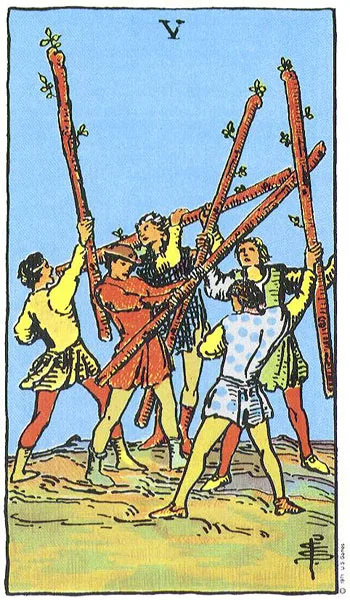
Five young men swing five staves in a chaotic tangle, each striking at nothing in particular. Look closely and no one is actually hurt: no blood, no fallen figure, staves clacking against staves rather than bodies. Their clothes are all different, five uniforms for five agendas. It reads as much like a rowdy training bout as a battle, and that ambiguity is the card's whole question: is this fight real, is it practice, or is it just noise?
Five of Wands: upright meaning
Nan kout: Everyone's competing and nobody's listening: it's noisy friction more than real threat, so don't take it personally.
Everyone is talking and nobody is listening. The Five of Wands is friction: competing egos, rival bids, a team pulling in five directions, the group chat on fire over something that will not matter in a month. Saturn in Leo grinds authority against pride. The useful truth inside the card: this conflict is usually more noise than damage, and sometimes it is even productive, the way sparring sharpens a fighter. Competition can surface the best idea if someone imposes rules on the scrum. But do not mistake motion for progress. Ask what is actually being decided here, and whether you need to be in the middle of it.
Five of Wands: Retounen
Nan kout: Si ou pa ka jwenn yon bagay ki sanble ak sa ou vle, ou ka eseye yon lòt bagay, tankou yon jwèt ki gen menm objektif la.
Reversed, the fight moves indoors: either the open conflict finally breaks and cooler heads prevail, or the clash goes internal and you war with yourself instead: competing goals, obligations, and identities all swinging staves inside one head. Watch also for conflict avoidance wearing the costume of peace; tension you refuse to name does not leave, it just runs the meeting from under the table. The reversal asks you to end the scrum deliberately. Concede the trivial points, name the real one, and fight only for that.
Five of Wands: Love & relasyon
Vertikal
Bickering, rivalry, or genuine competition for someone's attention. In couples, small disagreements are multiplying: usually not one big issue but five little ones fighting for airtime. If dating, you may be one of several suitors and can feel it. Some friction is chemistry; the test is whether arguments resolve anything or just repeat.
Retounen
Si se pa sa, li ka montre ke ou pa gen okenn konfyans nan tèt ou. Si ou pa gen konfyans nan tèt ou, li ka montre ke ou pa gen konfyans nan tèt ou. Si relasyon an te ale byen apre yon moman difisil, tcheke si bagay yo te rezoud oswa si yo te sèlman kite.
Five of Wands: Kariè & lajan
Vertikal
A competitive arena: rival candidates for the role, departments fighting over budget, a meeting culture where the loudest draft wins. Handled well, the contest can raise everyone's game. Financially, beware bidding wars and ego purchases: competition makes people overpay. Bring rules, criteria, and a referee to any decision currently being made by volume.
Retounen
Tension Workplace se swa de-eskalasyon oswa ale anba tè nan silans, cliques, ak sabotaj kalm. Si ou se echwe pa konpetisyon anndan, sa a kat validation pandye soti nan konpetisyon ki pa t 'gen valè pou genyen. Redirect enèji nan yon batay pwofesyonèl ki reyèlman avanse ou.
Five of Wands: Wi oswa non?
Non.
Lean no. The Five of Wands says the path to what you asked about runs through conflict, competition, and scattered effort: achievable perhaps, but contested at every step and probably more costly than it looks. If your question was about harmony, agreement, or an easy outcome, the answer is no for now. Reduce the number of battles first, then ask again.
Kat ki gen rapò
Kesyon ki poze souvan
Èske kat sa a ka jwenn ou jodi a?
Tire kat sa a nan yon lekti viv →