D'Spill vun de Wands · 7 vun Wands
Siwen vum Stab Lëscht vun de Tarot-Karten
- Vertikal
- Verteidegungd'Grondlage erhalenVirdeeler haleniwwerzeegenënner Drock stoen
- Ëmgedréit
- iwwerwältegendLand opginnVerteidegungErschöpfung
- Ja oder Nee
- Vläicht
- Element
- Fire
- Astronomie
- Mars in Leo
Wat d'Kaart weist
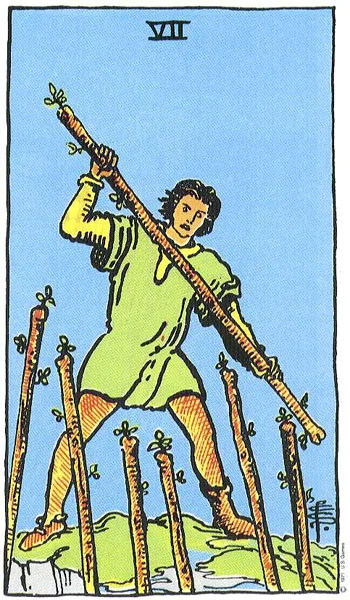
A man stands on high ground swinging one stave down at six others thrusting up from below: the challengers themselves are unseen, only their weapons visible over the ledge. He has the advantage of position and clearly means to keep it. One odd detail: he wears mismatched footwear, a shoe and a boot, as if the fight arrived before he finished dressing. The defense is real, urgent, and slightly improvised.
Siwen vum Stab: Oppene
An der Kuerzform: Et ass eng Plaz, wou een sech ophalen an erëm ufänken kann, sech ze beweegen.
You are above, and they are coming. The Seven of Wands is what follows success or conviction: the moment your position, opinion, or territory attracts challengers, and you discover whether you actually believe in it. Mars in Leo defends with heart: this is not cold strategy but a fighter's loyalty to their own ground. The card says the high ground is yours and worth keeping, but it never pretends the pressure is imaginary. Expect to justify yourself, to be tested, to hold a line while tired. The mismatched shoes are the honest part: nobody feels fully ready for this fight. Fight it anyway.
Siwen vum Stab: Reversed meaning
An der Kuerzform: Et gëtt och nach eng Rei aner Referenzen, déi awer net méi relevant sinn.
Reversed, the ledge is crumbling, or you are defending it long past the point of sense. Overwhelm is the common reading: too many fronts, too little support, a position held on empty. But look also for defensiveness as reflex, where every question feels like an attack and every suggestion like a siege. Not all six staves belong to enemies; some may be offers of help held wrong. The reversal asks a brutal, useful question: is this ground still worth the cost of holding it? Retreat chosen deliberately is strategy. Collapse is not.
Siwen vum Stab: Relatiounen
Vertikal
Defending the relationship: against disapproving families, interfering exes, or friends with opinions. Also, sometimes, defending yourself within it: holding a boundary, insisting on being taken seriously. If single, expect competition or scrutiny around someone you want. The card backs you, provided what you are defending is the connection and not just your pride.
Ëmgedréit
D'Erschöpfung vun der Bezéiung, déi eenzel fir eng Bezéiung kämpft, oder eng Dynamik wou ee vun Iech all Gespréich als Kräizverhör behandelt. Konstant Verteidegung ass net Intimitéit. Setzt d'Stäerkt laang genuch erof fir ze kontrolléieren: ass et eng real Bedrohung, oder ass Wachsamkeet d'ganz Klima vun der Bezéiung ginn?
Siwen vum Stab: Karriär & Geld
Vertikal
D'Spill ass ganz einfach, an et gëtt keng Zäit fir ze denken, wat een do maache soll. Et ass eng ganz einfach Aktioun, déi een einfach maache kann. D'Spill ass ganz einfach, an et gëtt keng Zäit fir ze denken, wat een do maache soll.
Ëmgedréit
Am Job op ze vill Fronten kämpfen, oder sech un eng Roll, en Client oder eng Strategie klammeren, déi méi kascht fir ze verteidegen wéi se bréngt. Permanent belägert ze sinn ass keng Stellebeschreiwung. Wielt deen eenzege Hiwwel, deen zielt, delegéiert oder léisst de Rescht falen; a wann déi ganz Positioun dervun ofhänkt, datt Dir ni rascht, dann ass dat d'Problem, dat et ze léisen gëtt.
Siwen vum Stab: Ja oder Nee?
Vläicht.
A maybe that leans yes if you are willing to fight for it. The Seven of Wands does not offer easy outcomes: it says the thing you asked about is attainable and defensible, but contested: you will need to hold your ground under real pressure to get it. If you have the conviction and stamina, read it as yes. If you were hoping it would come without a fight, it will not.
Relativiséierte Karten
Häufig gestallt Froen
Wéi ass dat haut mat der Geschicht?
Dës Kaart an engem Live-Liesen zielen →