Ko te āhua o nga pāpāho · 7 o Wands
E whitu nga rākau Ko te tikanga o te kāri Tarot
- Tūtū
- Whakahauhaute tū i tō tātou whenuate pupuri i te paingate whakaponoi raro i te whakamātautau.
- Whakawhitiwhiti
- te whakawhāitite whakawātea i te whenuate parengate whakawhāititanga.
- He, He
- Tērā pea
- Ko te huānga
- Fire
- Astrology
- Mars in Leo
Ko te mea e whakaaturia ana e te kāri
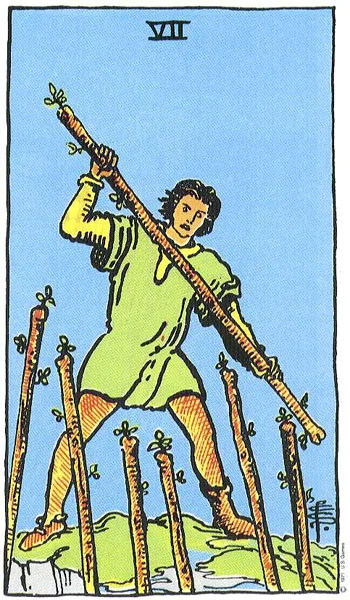
A man stands on high ground swinging one stave down at six others thrusting up from below: the challengers themselves are unseen, only their weapons visible over the ledge. He has the advantage of position and clearly means to keep it. One odd detail: he wears mismatched footwear, a shoe and a boot, as if the fight arrived before he finished dressing. The defense is real, urgent, and slightly improvised.
E whitu nga rākau: te tikanga tūtū
I roto i te poto: Your position is being challenged: stand your ground and find out you really do believe in it.
You are above, and they are coming. The Seven of Wands is what follows success or conviction: the moment your position, opinion, or territory attracts challengers, and you discover whether you actually believe in it. Mars in Leo defends with heart: this is not cold strategy but a fighter's loyalty to their own ground. The card says the high ground is yours and worth keeping, but it never pretends the pressure is imaginary. Expect to justify yourself, to be tested, to hold a line while tired. The mismatched shoes are the honest part: nobody feels fully ready for this fight. Fight it anyway.
E whitu nga rākau: ko te tikanga whakarerekē
I roto i te poto: E pare ana koe i nga mata maha, i te whakawhāiti rānei; ka whakakoretia nga pakanga kāore anō kia whai tikanga.
Reversed, the ledge is crumbling, or you are defending it long past the point of sense. Overwhelm is the common reading: too many fronts, too little support, a position held on empty. But look also for defensiveness as reflex, where every question feels like an attack and every suggestion like a siege. Not all six staves belong to enemies; some may be offers of help held wrong. The reversal asks a brutal, useful question: is this ground still worth the cost of holding it? Retreat chosen deliberately is strategy. Collapse is not.
E whitu nga rākau: te aroha me ngā pātahitanga
Tūtū
Defending the relationship: against disapproving families, interfering exes, or friends with opinions. Also, sometimes, defending yourself within it: holding a boundary, insisting on being taken seriously. If single, expect competition or scrutiny around someone you want. The card backs you, provided what you are defending is the connection and not just your pride.
Whakawhitiwhiti
Ko te whakangahau mai i te whawhai mo tētahi pātahitanga kotahi, he hihiri rānei i reira ko tētahi o koutou e whakaaro ana i ia kōrero hei whakamātautau. Kāore te parenga tūturu i te āhua o te āhua o te āhua o te āhua o te pātahitanga. Ka whakatū i te kāhua kia roa rawa hei arotake: he mōrearea tūturu, kua noho te arotahi ki te āhua o te pātahitanga katoa rānei?
E whitu nga rākau: mahi me te moni
Tūtū
Your position is enviable and therefore contested: rivals for the role, pushback on your project, credit others would like to claim. Hold the line: this card favors defending turf, negotiating from strength, and refusing to be argued out of work you know is good. Financially, resist pressure to sell, settle, or discount early.
Whakawhitiwhiti
Fighting on too many fronts at work, or clinging to a role, client, or strategy that costs more to defend than it returns. Being permanently embattled is not a job description. Choose the one hill that matters, delegate or drop the rest, and if the whole position depends on you never resting: that is the problem to solve.
E whitu nga rākau: He aha, he kore rānei?
Tērā pea.
A maybe that leans yes if you are willing to fight for it. The Seven of Wands does not offer easy outcomes: it says the thing you asked about is attainable and defensible, but contested: you will need to hold your ground under real pressure to get it. If you have the conviction and stamina, read it as yes. If you were hoping it would come without a fight, it will not.
E pā ana ki ngā kāri
Ko nga pātai e pā ana
Ka kitea e tēnei kāri koe i tēnei rā?
Ka tangohia tēnei kāri ki roto i tētahi akoranga ora →