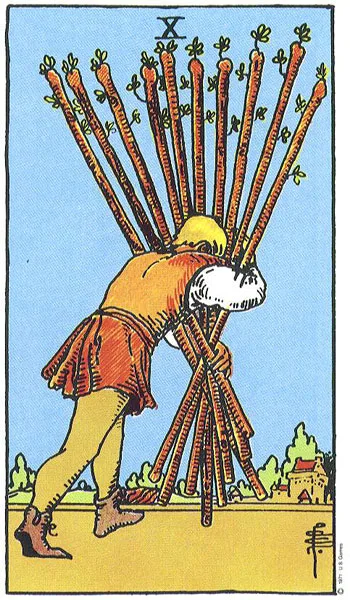
Trazo de varillas · 10 de Wands
dez de trevos Significado das cartas do tarot
- Vertical
- Sobrecargacargalo tododebertramo finaléxito que se fai pesado
- Invertido
- poñelo abaixodelegacióncolapsoliberación
- Si ou Non
- Non
- Elemento
- Fire
- Astroloxía
- Saturn in Sagittarius
O que mostra a tarxeta
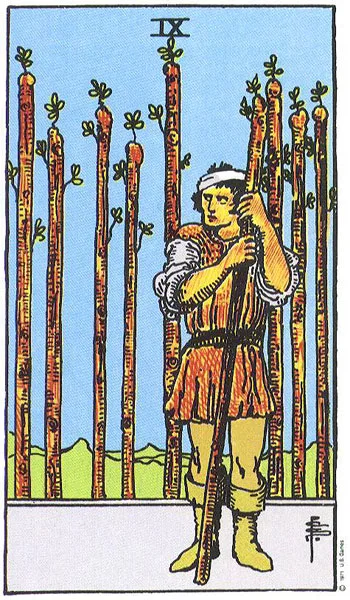
A man carries all ten staves at once, bundled awkwardly in his arms so that they block his own view of the road. He is bent forward under them, walking toward a town that sits close on the horizon: the destination is genuinely near. Nothing in the image forces him to carry every stave in one trip; that was a choice, made so long ago it no longer feels like one. The card is effort at the exact point where it stops being noble.
dez de trevos: significado vertical
En resumo: Levas moito máis do que debes levar. A maioría desta carga é opcional, así que comeza a poñer algo.
The load is real, and most of it is optional. The Ten of Wands is what success becomes when you never learn to decline: every project accepted, every favor absorbed, every responsibility bundled onto one back until the work of carrying crowds out the reason for the journey. Saturn in Sagittarius is exactly this: duty strapped onto a fire that wanted to run free. The card acknowledges you are close; the town is right there, and sometimes the honest advice is simply to finish the haul. But it insists you look at the bundle. Which staves are yours? Which did you pick up because no one else moved fast enough? Deliver the load, then stop restocking it.
dez de trevos: significado inverso
En resumo: A carga ou cae ou é deliberadamente posta abaixo; delega, e di o atrasado non a propósito.
Reversed, the bundle either drops or gets put down, and the difference matters enormously. The good version is release: delegating at last, resigning from the committee, saying the overdue no, feeling your spine unbend. The hard version is collapse: the back gives out, the deadline blows, the burnout arrives with interest because the load was never voluntarily reduced. Reversed, this card is usually the last warning before the choice gets made for you. There is also a quieter reading: carrying burdens invisibly, insisting you are fine while visibly buckling. Whoever you are protecting from the truth is not being protected.
dez de trevos: amor e relacións
Vertical
Unha persoa leva a relación, a planificación, o traballo emocional, o traballo de reparación despois de cada discusión. Pode ser amor, pero tamén é carga, e o portador está demasiado inclinado para gozar da persoa pola que o fai. Redistribuír antes de que o resentimento remate de compoñerse. O deber non é o mesmo que a devoción.
Invertido
O compañeiro sobrecargado remata, ou finalmente entregando as responsabilidades, ou colapsándose silenciosamente da relación baixo elas. Se as cousas se sentiron pesadas, este é o momento de renegociar os papeis honestamente en vez de ver caer todo o acordo. Ás veces isto marca a liberación despois dunha ruptura: dor, pero tamén lixeireza.
dez de trevos: carreira e cartos
Vertical
You are the person everything gets routed to, and it is costing you. Overtime normalized, scope creeping, three roles under one title, often because competence gets rewarded with more weight rather than more money. Finish the current commitment if the end is genuinely near, then renegotiate: fewer staves or a heavier paycheck. Financially, debts and obligations need consolidating, not accumulating.
Invertido
Either delegation finally happens (a team hired, a workload rebalanced, a role right-sized) or something drops publicly: the missed deadline, the resignation written at midnight. Get ahead of it. Offload the two heaviest obligations this week, and stop measuring your worth by tonnage carried.
dez de trevos: Si ou non?
Non.
Non, non porque o obxectivo sexa imposible, senón porque o camiño actual cara a el custa máis do que vale a resposta. O Dez de Bastos responde as preguntas sobre tomar máis co non, e as preguntas sobre continuar como está co "non así". Se podes aliviar radicalmente a carga primeiro, pregúntao de novo; levado desta maneira, o si que queres convértese noutra pauta.
Tarxetas relacionadas
Preguntas frecuentes
Esta carta atopárache hoxe?
Tira esta tarxeta nunha lectura en directo →