Kostim · 9 nan Wands
Nwa de baton Tarot Card siyifikasyon an
- Vertikal
- rezistansdènye pouspwotejete teste nan bataypersistance
- Retounen
- burnoutparanoyamiray twò worefize èd
- Wi oswa Non
- Petèt
- Eleman
- Fire
- Astrologi
- Moon in Sagittarius
Ki sa kat la montre
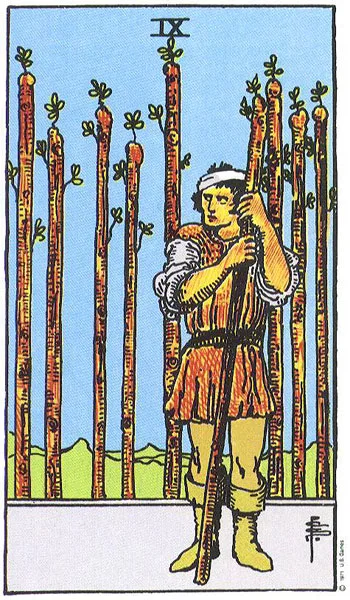
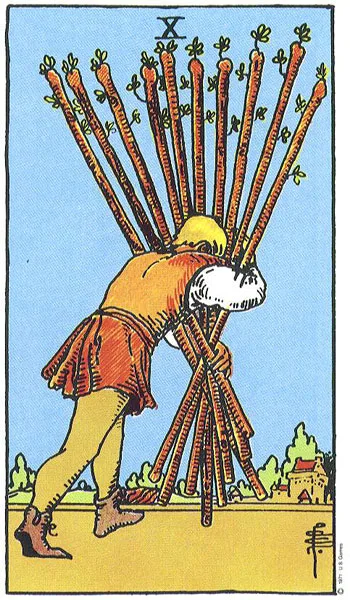
Yon moun ki gen yon bandaj sou tèt li, li chita sou yon sèl baton, je l' sou bò gòch, li gade. Nan dèyè l', gen 8 baton ki chita sou yon palisad ki pa gen okenn fòm, ki pwoteje l'. Yon ti kras sou tèt li, li gen yon ti blese, men li rete kanpe, li kenbe baton l' tankou yon moun ki espere yon lòt batay epi ki vle reponn yon ti son. Tout atitid kat la viv nan je l' sou bò gòch la: li blese, li pè, li pa janm bat.
Nwa de baton: upright meaning
Nan kout: You're battered and still standing, closer to the finish than you feel. Hold on a little longer.
You are more durable than you feel. The Nine of Wands arrives late in a long fight, after setbacks that would have justified quitting, and finds you still standing, guarded, tired, and closer to the end than you can see. Its message is double. First: the wariness is earned; you learned real lessons and they are armor now. Second: do not stop here. This is the second-to-last card of the suit for a reason: one more push, one more defense, one more week of holding on tends to decide the whole campaign. Rest inside the palisade if you must. Just do not mistake the pause for the finish.
Nwa de baton: Retounen
Nan kout: Armor a te viv soti nan lagè a; ou ap kouri sou vapè ak refize èd, se konsa kite kèk nan li desann.
Reversed, the defense has outlived the war. Burnout is the loudest reading: running on fumes, held together by tape and stubbornness, refusing help because accepting it feels like weakness. The subtler reading is armor grown into skin: expecting betrayal everywhere, reading neutral events as attacks, building walls so high nothing gets in, including the good things. Every wound in your history was real; not every stranger is here to add one. The reversal asks you to distinguish vigilance from injury. Put down what you can. Some of what you are guarding stopped being under threat a while ago.
Nwa de baton: Love & relasyon
Vertikal
Loving while braced. Past relationships left marks, and you or your partner approach intimacy like a guarded checkpoint: slow to trust, quick to defend. The card honors that history and still nudges the gate open: the connection in question is likely worth the risk of lowering one stave. Persistence through a rough patch is favored for couples.
Retounen
Ou ka gen yon relasyon ki gen anpil doulè, tankou yon relasyon ki gen anpil pwoblèm, tankou yon relasyon ki gen anpil pwoblèm, tankou yon relasyon ki gen anpil pwoblèm, tankou yon relasyon ki gen anpil pwoblèm, tankou yon relasyon ki gen anpil pwoblèm, tankou yon relasyon ki gen anpil pwoblèm, tankou yon relasyon ki gen anpil pwoblèm, tankou yon relasyon ki gen anpil pwoblèm, tankou yon relasyon ki gen anpil pwoblèm, tankou yon relasyon ki gen anpil pwoblèm, tankou yon relasyon ki gen anpil pwoblèm, tankou yon relasyon ki gen anpil pwoblèm, tankou yon relasyon ki gen anpil pwoblèm, tankou yon relasyon ki gen anpil pwoblèm, tankou yon relasyon ki gen anpil pwoblèm, tankou yon relasyon ki gen anpil pwoblèm, tankou yon relasyon ki gen anpil pwoblèm, tankou yon relasyon ki gen anpil pwoblèm, tankou yon relasyon ki gen anpil pwoblèm, tankou yon relasyon ki gen anpil pwoblèm, tankou yon relasyon ki gen anpil pwoblèm.
Nwa de baton: Kariè & lajan
Vertikal
The project is at the grind stage: most of the distance covered, resources thin, motivation thinner, finish line real but not yet visible. Hold. This card strongly favors seeing long efforts through: the qualification, the turnaround, the last quarter of a hard year. Financially, defend what you have built; guard reserves and honor the budget that got you here.
Retounen
Burnout in progress, possibly disguised as dedication. Working defensively (hoarding tasks, trusting no one, treating every meeting as an ambush) is a signal, not a strategy. Delegate before something gives, and reassess whether this fight is the career or just a hill someone told you to hold years ago.
Nwa de baton: Wi oswa non?
Petèt.
Nan ka sa a, li pral pi fasil pou ou jwenn yon bagay ou vle fè. Nan ka sa a, li pral pi fasil pou ou jwenn yon bagay ou vle fè. Nan ka sa a, li pral pi fasil pou ou jwenn yon bagay ou vle fè. Nan ka sa a, li pral pi fasil pou ou jwenn yon bagay ou vle fè.
Kat ki gen rapò
Kesyon ki poze souvan
Èske kat sa a ka jwenn ou jodi a?
Tire kat sa a nan yon lekti viv →