Suit of Wands · 2 of Wands
kalih Tarot Card tegese
- Tegak
- rencanaambisipilihan bobotdonya ing tangancakrawala sabanjuré
- Dibalik
- main amantakut ninggalrencana sing alaora tenang
- Iya utawa Ora
- Iya
- Unsur
- Fire
- Astronomi
- Mars in Aries
Apa sing ditampilake kartu
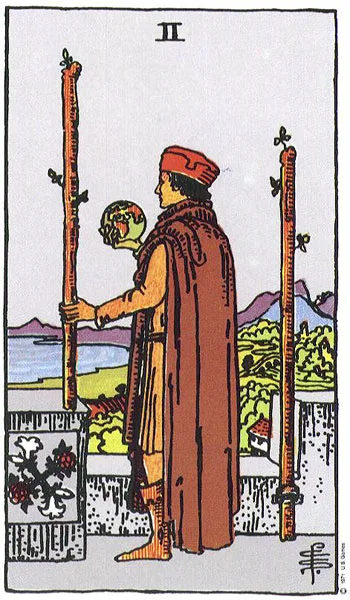
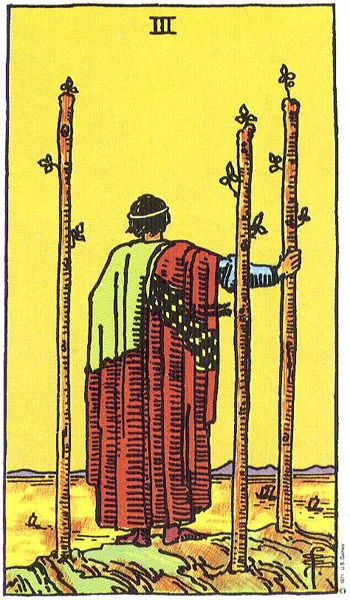
A man in rich clothes stands on the parapet of his own castle, a small globe cradled in one hand while he gazes out over sea and shoreline. One wand is bolted to the wall behind him (secured, already achieved) and he grips the second loosely, still portable. Roses and lilies are crossed on the stonework, desire and thought held in balance. He owns everything behind him and is visibly bored by it; his eyes are on the water.
kalih: upright meaning
Cekak: Dina mangsa éta, éta diwangun ku dua bagian: bagian mimiti, anu diwangun ku wangunan-wangunan anu diwangun dina jaman Romawi.
This is the card of the person who has succeeded at the small version and is now eyeing the large one. You stand somewhere secure: a stable job, a working routine, a first accomplishment, and the view no longer satisfies. The Two of Wands is planning with teeth: not idle daydreaming but the real work of mapping a bolder future, comparing routes, deciding what you are willing to risk. Mars in Aries gives it nerve. The decision in front of you is usually between the comfortable known and the promising unknown, and the card leans unmistakably toward the horizon. Stay on the balcony too long and it becomes a wall.
kalih: Reversed meaning
Cekak: Anjeun ngarencanakeun langkung ti cara pikeun ngajaga, atanapi rasa takut pikeun lengkah tetep anjeun dina balkon; nyandak langkah nyata.
Reversed, the globe stays in the hand and the feet stay on the balcony. You may be over-planning as a form of hiding: endlessly researching the move, the launch, the trip, because planning feels like progress and costs nothing. Or the reverse problem: you leapt without a map and the venture is wobbling for lack of one. Either way the balance between vision and action has tipped. Ask honestly which one you are avoiding. Fear of leaving what works is human, but the restlessness you feel will not be argued away; it will wait.
kalih: tresna & hubungan
Tegak
A relationship at a deciding point: moving in, going long-distance, taking a shared risk like relocating together. The card favors the bolder path chosen deliberately, not impulsively. For single people it often means widening the territory: new circles, new places, dating beyond the usual type. What you want is out past the familiar shoreline.
Dibalik
One foot in, one foot out. You or a partner may be staying because it is comfortable rather than because it is chosen, quietly scanning the horizon while standing still. Unspoken plans breed resentment. Say the ambition out loud (the future you are privately mapping) and find out whether it can be a shared one.
kalih: karier & dhuwit
Tegak
Expansion is on the table: a bigger role, a new market, a business partner, working abroad. You have proof of concept; the question is scale. Financially the Two of Wands supports calculated risk: money deployed against a researched plan rather than left idle. Compare your options ruthlessly, pick one, and commit resources to it.
Dibalik
Planét ieu diwangun ku dua lapisan, hiji lapisan anu ngandung cai, anu séjénna nyaéta lapisan anu ngandung gas, sarta diwangun ku sababaraha lapisan anu ngandung cai. Dina lapisan ieu aya sababaraha lapisan anu ngandung cai, nyaéta lapisan anu ngandung gas, nyaéta lapisan anu ngandung cai, nyaéta lapisan anu ngandung gas, nyaéta lapisan anu ngandung cai.
kalih: Iya utawa ora?
Iya.
A yes, with homework attached. The Two of Wands says the ambition is sound and the wider world is genuinely available to you, but it is a planner's card, so the yes assumes you do the mapping before you sail. If your question is whether to expand, commit, or take the bolder option, the answer is yes: deliberately, with a route drawn.
Kartu terkait
Takon-takon kang kerep diajukake
Kartu iki bakal nemokake kowe dina iki?
Tarik kartu iki ing bacaan langsung →