Ko te āhua o nga kōaro · 13 o Cups
Te Queen o nga Hānana Ko te tikanga o te kāri Tarot
- Tūtū
- He tino mārama te whakaarote mātauranga ā-āhuatangate mātaurangate tūponotangate hangangate hanganga haumaru.
- Whakawhitiwhiti
- Ko te whakawhāititia o te āhuangā rohenga pūte whakawhāititangate whakamātautau i te āhua.
- He, He
- He
- Ko te huānga
- Water
- Astrology
- Water of Water
Ko te mea e whakaaturia ana e te kāri
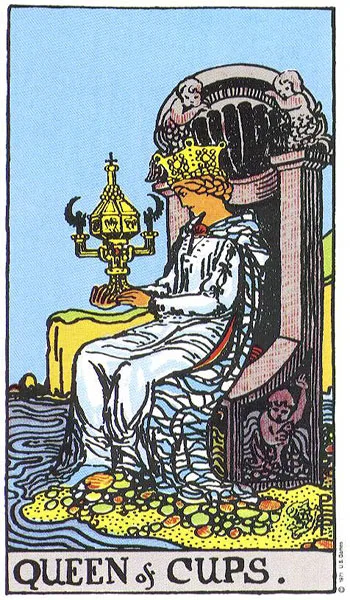
A queen sits on a throne at the sea's very edge, so close that water laps the stones at her feet and the border between land and ocean blurs. Her throne is carved with sea-children and shells, and she gazes with complete absorption at the cup in her hands: a closed, ornate vessel with angel-shaped handles, the only lidded cup in the entire deck. Pebbles and sea glass glitter around her. She holds the mystery without opening it, which is precisely the skill the card is about.
Te Queen o nga Hānana: te tikanga tūtū
I roto i te poto: Deep feeling with real mastery: hold other people's unspoken things without drowning in your own.
E whakaaro ana ia ki nga mea katoa, a, kaore e whakarewa i roto i te mea katoa. Ko te Queen of Cups he hōhonu ā-
Te Queen o nga Hānana: ko te tikanga whakarerekē
I roto i te poto: Kua whakawāteatia oe i oe nga rohenga, ā, kua whakawāteatia te arotahi ki te whakangahau; e whakaaro ana i oe tōna ake whakaaro tuatahi.
Reversed, the sea comes over the throne. Boundaries go porous: other people's moods weather straight through you, every request finds a yes it should not, caretaking swells into martyrdom with a ledger of unthanked sacrifices attached. Or the depth turns inward and floods: emotions running the calendar, intuition indistinguishable from anxiety, self-soothing sliding toward numbing. Its sharpest reversed face is feeling used as instrument: guilt deployed, tears aimed, sensitivity weaponized in either direction. The repair is the upright Queen's forgotten posture: she sits at the water's edge, not in the surf. Re-draw the line between your feelings and everyone else's. Compassion without a shoreline is just erosion.
Te Queen o nga Hānana: te aroha me ngā pātahitanga
Tūtū
Love that actually listens. This card marks relationships, or partners, or your own readiness, defined by emotional safety: being heard without judgment, held without agenda. If single, it favors the deeply feeling connection over the exciting-but-shallow one, and may describe an empathic person entering your story. In couples, it prescribes the Queen's specialty: presence. Put the phone down and hear what is under the words.
Whakawhitiwhiti
Loving past your own waterline: absorbing a partner's every mood, managing their feelings as a second job, mistaking being needed for being loved. Or intuition curdled into suspicion, reading tea leaves in text messages. Sometimes it flags emotional manipulation in the dynamic, from either side. Refill your own cup first; a drained Queen reads every sea wrong.
Te Queen o nga Hānana: mahi me te moni
Tūtū
Ko te mōhiotanga ā-ā
Whakawhitiwhiti
The office therapist role has consumed the actual job: absorbing everyone's crises, staying late from guilt, mistaking being indispensable emotionally for being valued professionally. Or feelings are flooding judgment: decisions made from anxiety, feedback taken as verdict. Install boundaries like infrastructure. Empathy is your gift; unbilled and unbounded, it becomes everyone else's resource and your depletion.
Te Queen o nga Hānana: He aha, he kore rānei?
He.
Yes, spoken quietly, from someone who can see farther into the water than you can. The Queen of Cups favors questions about love, trust, healing, and intuition: the answer is yes, and your own gut has likely been saying so already. Her condition is that you honor the feeling truth of the situation, not just its logistics. Where boundaries are the question, her yes means yes to the boundary.
E pā ana ki ngā kāri
Ko nga pātai e pā ana
Ka kitea e tēnei kāri koe i tēnei rā?
Ka tangohia tēnei kāri ki roto i tētahi akoranga ora →