Major Arcana · 20
Judgement Tarot Card Meaning
- Upright
- awakeningreckoningthe callrebirthabsolution
- Reversed
- ignoring the callharsh self-judgmentstalled rebirthunheeded lessons
- Yes or No
- Yes
- Element
- Fire
- Astrology
- Pluto
What the card shows
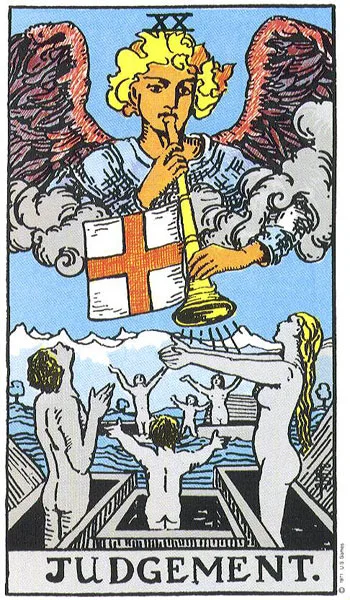
High among banked clouds, a great angel leans out of heaven blowing a golden trumpet, a square white banner marked with a red cross hanging from its horn. Below, on a wide gray sea, coffins float open like boats, and the dead rise from them, a man, a woman, a child in the foreground, gray-skinned, arms lifted or spread in wonder, answering a sound the whole world can hear. Snow-capped mountains close the horizon. No one shown is being condemned. Everyone shown is getting up.
Judgement: upright meaning
In short: A reckoning and a call to rise are here — forgive the past clearly and answer the summons you've been ignoring.
A summons has gone out, and some part of you has already heard it. Judgement marks the great reckoning moments of a life: the honest summing-up of a long chapter, the verdict you finally render on your own past, and the call, sometimes literal, a diagnosis, an offer, a question at 2 a.m., to rise into a bigger version of your life. Absolution is the card's secret gift: the past reviewed clearly, its lessons extracted, its weight set down. Notice that everyone in the picture rises; no one is condemned. Answer the call you have been pretending not to hear. It does not repeat indefinitely, and you already know which one it is.
Judgement: reversed meaning
In short: You're refusing the call, or endlessly punishing yourself for the past; forgive specifically and take one concrete step.
The trumpet is sounding and the coffin lid is staying shut. Reversed, Judgement shows the call refused: the vocation deferred one more year, the life change everyone including you can see is due, the same lesson circling back untaken. Its other face is the inner judge gone rogue, self-criticism so relentless that no verdict is ever final and no past mistake ever done being paid for. Both are stalls, one avoids the future, one imprisons the past. Two motions break the deadlock: forgive yourself specifically, in writing if needed, and take one concrete step toward the summons. Rebirth resumes the moment either lid cracks.
Judgement: love & relationships
Upright
A moment of truth for the heart: an honest review of the relationship's whole arc, a decisive conversation, or a reunion, with a person or with a part of yourself, that resurrects what seemed finished. Old wounds can be genuinely absolved now. Choose the future consciously rather than drifting into it.
Reversed
A verdict is being dodged, the talk that would settle things, the pattern from past relationships still running unexamined, or a self-blame so loud it drowns a present partner's actual voice. Stop relitigating the past inside your head and bring the case into the open, where it can finally close.
Judgement: career & money
Upright
The vocational card: a calling grows insistent, a career reinvention comes due, or a long professional chapter reaches its honest summing-up, results tallied, growth visible, next level unlocked. Evaluations and decisions land largely in your favor. Financially, review the full record and settle old accounts; a clean ledger funds the rebirth.
Reversed
The calling is being ignored on schedule, another year in work you have outgrown, or past professional stumbles are being repeated because their lesson was never sat with. Harsh self-review may be masquerading as standards. Extract the actual lesson, drop the sentence you keep serving, and answer the pull you already feel.
Judgement: yes or no?
Yes.
Yes, particularly for questions of change, renewal, and second chances. Judgement affirms the leap you are contemplating, provided you have honestly reckoned with what came before; it is a yes earned through review, not luck. If your question was whether to answer a call, take a decision, or begin again, rise and answer it. The trumpet rarely sounds twice for the same door.
Related cards
Frequently asked questions
Would this card find you today?
Pull this card in a live reading →